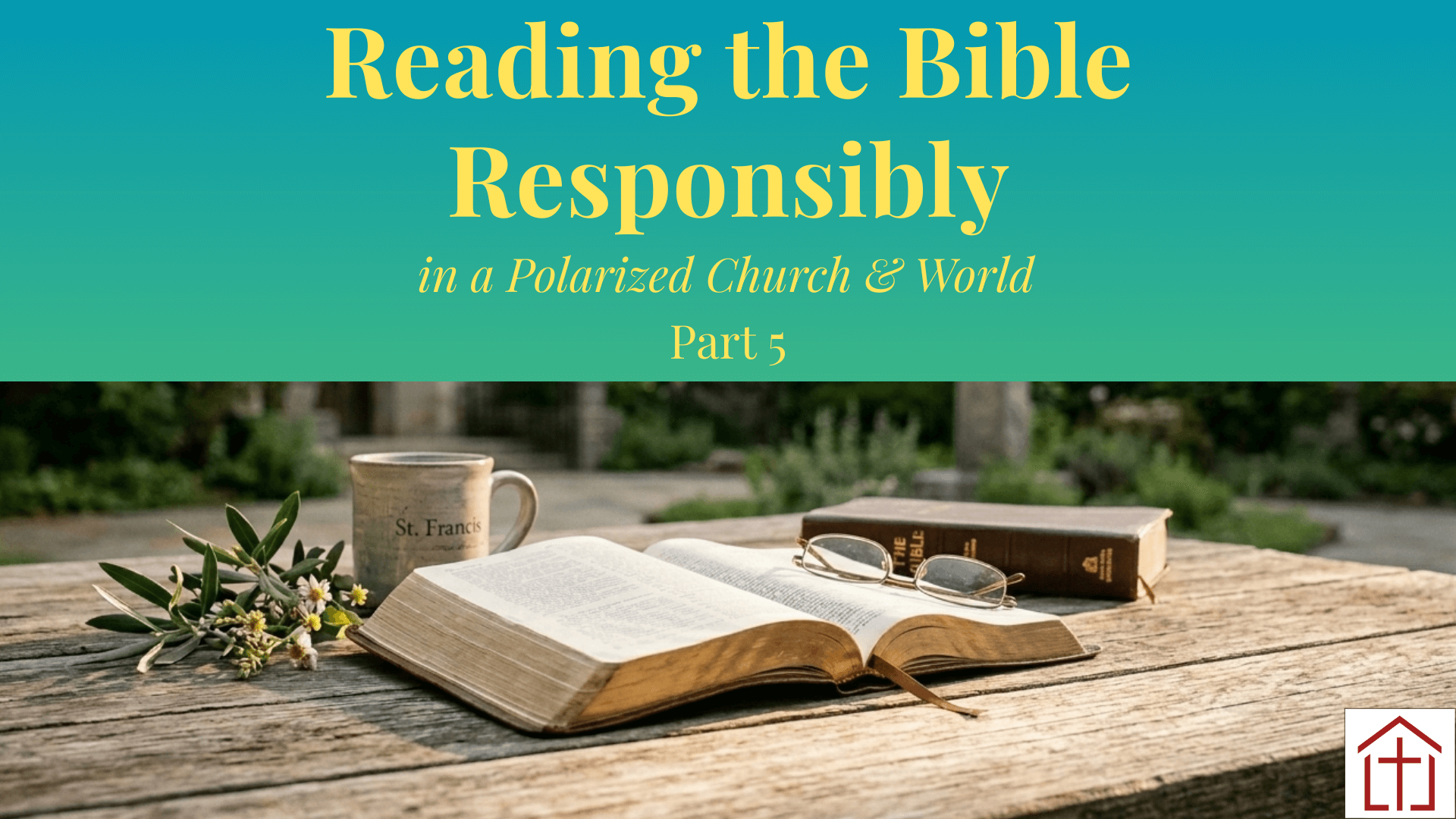
Reading the Bible Responsibly in a Polarized Church & World – Part 5
Opening Prayer
As the light of dawn awakens earth’s creatures and stirs into song the birds of the morning, so may I be brought to life this day. Rising to see the light, to hear the wind, to smell the fragrance of what grows from the ground, to taste its fruit and touch its textures, so may my inner senses be awakened to you, so may my senses be awakened to you, O God.
- John Philip Newell, Celtic Benediction, p. 50.
Reading the Bible Responsibly in a Polarized Church & World:
The Bible’s content in many ways engages its readers – puzzling, angering, challenging, and inspiring them. How has the Bible historically been used, including with the issue of slavery? Can readers navigate the use of biblical texts that are quoted across the political spectrum? What principles exist for interpreting these texts that support conflicting viewpoints? Together, we will explore a way forward: reading the Bible with each other guided by the rule of love.
Four Approaches to Reading the Bible (cont’d)
Note: None of these labels is perfect, but they work in a general sense to help us recognize four broadly different approaches to biblical interpretation. These are broad terms and are used recognizing that different churches, theologians, scholars, individuals, and even mystics will naturally read the Bible in many different ways. Many people will not necessarily identify with one (or any) of these four approaches. Some may identify with more than one.
The Contemplative Approach
“To read the Bible like a contemplative means to embrace it as a text filled with mystery and wonder. A contemplative approach rejects both the authoritarian and atheist approaches as too limited or one dimensional, and while it appreciates the thoughtful knowledge and understanding that the academic approach makes available to us, a contemplative approach remembers that the primary purpose and value of the Bible rests in its spiritual meaning and wisdom – despite its cultural blind spots and limitations. Contemplatives read the Bible not to blindly obey it, or dismissively reject it, or even just to critique it but always primarily as an invitation into the spiritual practice of prayer, meditation, and contemplation. They respect the fact that it was written centuries ago in languages that most of us today do not speak; because of its age, as well as cultural and literary otherness, there is always an element of mystery surrounding the text. A contemplative reading stresses the humility of remembering that there is so much we don’t know – not only about the Bible but about God. But there is still a basic trust that key messages, such as ‘God is love,’ ‘love your neighbors,’ ‘be forgiving,’ and ‘do not judge’ carry universal meaning and therefore can be reliable guideposts for living a spiritually meaningful life today. Contemplatives appreciate the bright light of good scholarship but recognize that the mystery embedded in these ancient Scriptures can never be fully unraveled. For contemplatives, the interplay of the light of reason and the darkness of unknowing is not a problem to be solved but a mystery to be embraced and explored.”
There Is No One Right Way to Read the Bible
“Both the authoritarians and the atheists are going to bristle at this principle because both groups are invested in the idea that their way of reading the text is the only correct way. Everyone who sees the text differently must be mistaken. Both true believers and skeptics read the Bible dualistically, which is to say with an attitude that only one possible interpretation is correct, and all other ways must therefore be mistaken. This approach can feel reassuring, especially if you gather plenty of evidence (and echo chambers) to support your one and only ‘right’ way of interpretation. But the price you pay for believing your way is the only way is a willful disregard of the experiences of others who simply have a different viewpoint and understanding than your own.”
“The other alternative, which is more challenging psychologically but healthier on an ethical and communal level, is to recognize that good people sometimes see the world differently and therefore will disagree – and even disagree radically. Once we accept this, we can begin to move from debate (where we try to prove who’s right and who’s wrong) to dialogue (where we humbly attempt to understand each other and learn from one another). This is difficult work, but it is necessary work. And it leads to the [premise]: that we need each other to effectively read the Bible (or any great book of spiritual wisdom).”
(Carl McColman, Read the Bible Like a Mystic, 2025.)
For this week: For reflection: What is the primary purpose and value of the Bible?
An invitation to our virtual participants: Discussion and comments are very much encouraged and welcomed. Online discussions can be held in the comments section in the upcoming post on Social Media for this week’s Deacon’s Reflection which is part of adult formation at St. Francis Episcopal Church.
Some Suggested Study Resources:
- The New Oxford Annotated Bible, NRSV, with the Apocrypha; 5 th edition.
- The Harper Collins Study Bible, NRSV, Fully Revised and Updated (Including Apocryphal
Deuterocanonical Books); Society of Biblical Literature; (e-book). - The Jewish Annotated New Testament, NRSV, 2 nd edition, Amy-Jill Levine and Marc Zvi Brettler,
editors; Oxford University Press.
Closing Prayer – Prayer of Blessing
The vitality of God be mine this day, the vitality of the God of life. The passion of Christ be mine this day, the passion of the Christ of love. The wakefulness of the Spirit be mine this day, the wakefulness of the Spirit of justice. The vitality and passion and wakefulness of God me mine, that I may be fully alive this day, the vitality and passion and wakefulness of God that I may be fully alive.
May the light of God illumine the heart of my soul.
May the flame of Christ kindle me to love.
May the fire of the Spirit free me to live this day, tonight, and forever. Amen.
- John Philip Newell, Celtic Benediction, p. 53.
“Reading the Bible Responsibly in a Polarized Church & World,” Deacon Joe Dzugan, St. Francis Episcopal Church,
2026.