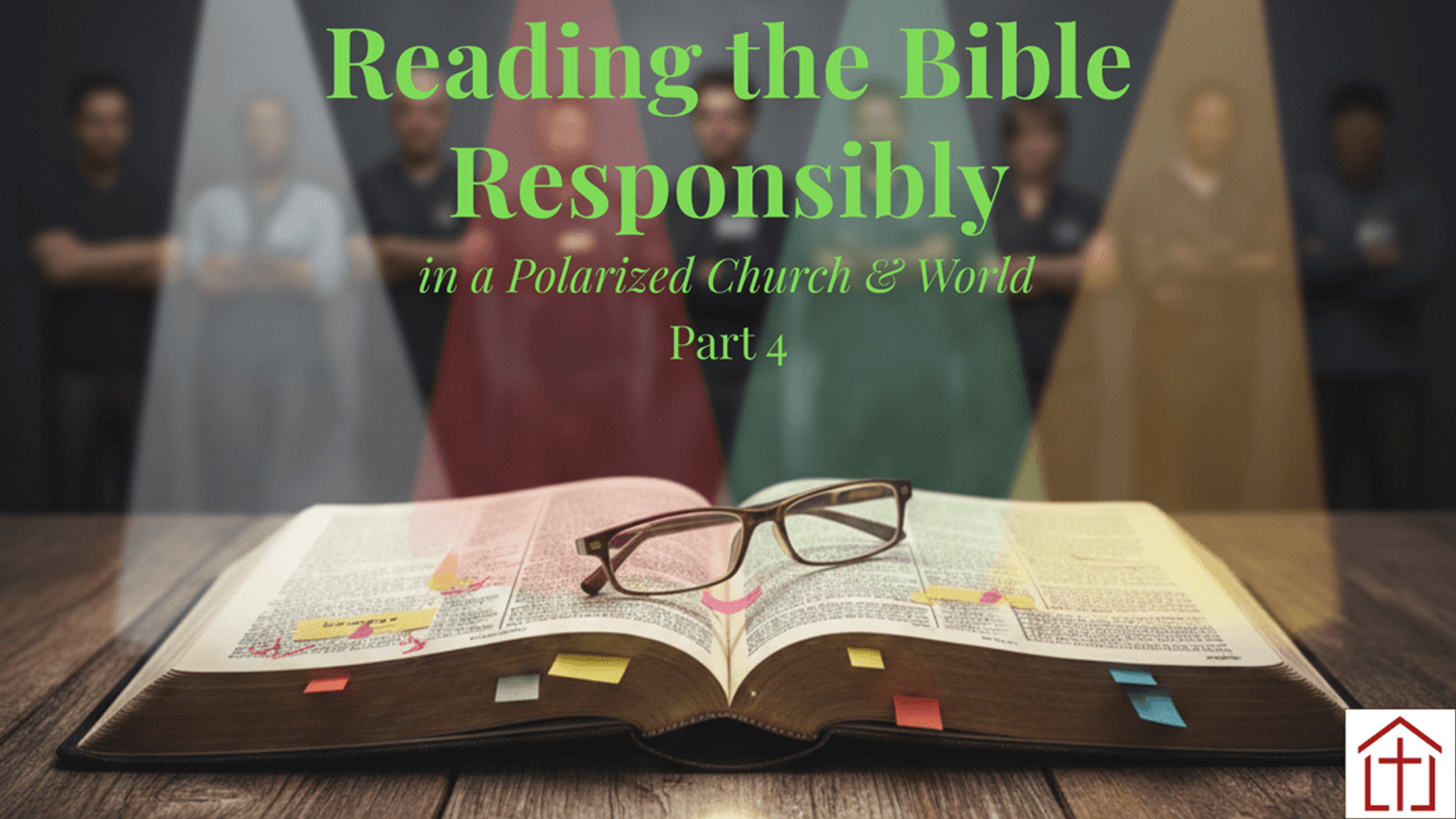
Reading the Bible Responsibly in a Polarized Church & World – Part 4
Opening Prayer
With the rising of the sun, life rises again within me, O God. In the dawning of the morning light, you lead me from the mists of the night into the clarity of the day. In the new light of this day, bring me to a clearer knowing of the mystery that first bore me from the dark. Bring me to a clearer knowing of the love from which all life is born.
- John Philip Newell, Celtic Benediction, p. 38.
Reading the Bible Responsibly in a Polarized Church & World:
The Bible’s content in many ways engages its readers – puzzling, angering, challenging, and inspiring them. How has the Bible historically been used, including with the issue of slavery? Can readers navigate the use of biblical texts that are quoted across the political spectrum? What principles exist for interpreting these texts that support conflicting viewpoints? Together, we will explore a way forward: reading the Bible with each other guided by the rule of love.
Four Approaches to Reading the Bible
Note: None of these labels is perfect, but they work in a general sense to help us recognize four broadly different approaches to biblical interpretation. These are broad terms and are used recognizing that different churches, theologians, scholars, individuals, and even mystics will naturally read the Bible in many different ways. Many people will not necessarily identify with one (or any) of these four approaches. Some may identify with more than one.
The Authoritarian Approach
“Authoritarian (or fundamentalist or ‘true believer’) readers think that the Bible should be literally understood as the inerrant word of God, as if the Spirit were whispering God’s thoughts into the minds of the biblical writers. The authoritarian perspective rests on the idea that throughout all of history and cultures of the world, God decided that humanity only gets one inerrant book of spiritual teachings, and the Bible is that one book. Authoritarians have a very hierarchical understanding of God and how the world works; in this way of seeing things, the Bible has absolute and supreme authority because of its status as the unquestionable word of the supreme deity. Our job is not to critique it or try to interpret it in the light of science or other branches of human knowledge, but to submissively conform our lives to its demands. Many fundamentalists insist there is no point in interpreting the Bible; you should just look for the ‘plain meaning’ of the text, although the plain meaning is not always so plain.”
The Atheist Approach
“Atheist, agnostic, and skeptical readers can be understood as the polar opposite of the fundamentalists and other ‘true believers.’ The atheists and skeptics believe that empirical science is the only truly reliable source of human knowledge and understanding – for all areas of life, including spirituality. Such readers not only reject the fundamentalist approach but also go so far as to refuse to consider that there is anything spiritually nourishing in Scripture. They might be willing to accept that some of the stories or poetry might have a limited value as descriptions of human wisdom, but overall they see the Bible as an ancient, outdated, superstitious, and prescientific book that, if anything, is a text to be mocked and derided. Atheists hold that most religious languages and ways of speaking cannot pass the test of logical or scientific rigor.”
The Academic Approach
“To read the Bible like an academic scholar, the keys to interpreting the text are history and literary criticism. This means one does not have to be a Christian believer to read the Bible in this way – while certainly many scholars are faithful, practicing Christians, others are agnostics or even atheists or, for that matter, members of other faith traditions. To read the Bible like an academic means to approach it not so much as a text for personal spiritual wisdom but simply to consider it in the light of sociology, psychology, philosophy, archaeology, and other scholarly disciplines. Academics find it interesting to consider what hidden subtexts might be present in any given passage of the Bible, who the intended audience was, how the historical and cultural issues or political concerns of the time impacted what was being said, and so forth. Bible scholars can help us have a more nuanced and meaningful understanding of every verse in the text. But even this approach can be limited; the problem with reading the Bible like an academic is that you can get lost in the abstract meaning of the text that you may no longer be able to read it for personal spiritual meaning. To academic scholars, the Bible is primarily a text to be interrogated, often with no end ever in sight.”
The Contemplative Approach
(to be continued)
(Carl McColman, Read the Bible Like a Mystic, 2025.)
For this week: For reflection: What is your concept of the authority of Scripture? What do you mean when you say “the Word of God”?
An invitation to our virtual participants: Discussion and comments are very much encouraged and welcomed. Online discussions can be held in the comments section in the upcoming post on Social Media for this week’s Deacon’s Reflection which is part of adult formation at St. Francis Episcopal Church.
Some Suggested Study Resources:
- The New Oxford Annotated Bible, NRSV, with the Apocrypha; 5 th edition.
- The Harper Collins Study Bible, NRSV, Fully Revised and Updated (Including Apocryphal
Deuterocanonical Books); Society of Biblical Literature; (e-book). - The Jewish Annotated New Testament, NRSV, 2 nd edition, Amy-Jill Levine and Marc Zvi Brettler,
editors; Oxford University Press.
Closing Prayer – Prayer of Blessing
O Sun behind all suns, O Soul within all souls, grant me the grace of the dawn’s glory, grant me the strength of the sun’s rays, that I may be well in my own soul and part of the world’s healing this day, that I may be well in my own soul and part of the world’s healing this day.
May the light of God illumine the heart of my soul.
May the flame of Christ kindle me to love.
May the fire of the Spirit free me to live this day, tonight, and forever. Amen.
- John Philip Newell, Celtic Benediction, p. 41.
“Reading the Bible Responsibly in a Polarized Church & World,” Deacon Joe Dzugan, St. Francis Episcopal Church,
2026.