Praying with Icons – Part 6
The Transfiguration
The Gospels of Matthew, Mark, and Luke tell us that Jesus took the three apostles Peter, James, and John, those he was closest to, and led them up a high mountain. There he was transfigured into blinding light; both his face and clothing changing before their eyes.
Matthew writes that “his face shone like the sun, and his clothes became dazzling white” (Matthew 17:2). Mark comments that his clothes were “such as no one on earth could bleach them” (Mark 9:3). And Luke describes how the Transfiguration took place while praying: “And while he was praying, the appearance of his face changed, and his clothes became dazzling white.” (Luke 9:29).
Then there before the eyes of the apostles appeared the Old Testament prophets Moses and Elijah talking to Jesus. However, only Luke mentions that they talked about the fate awaiting Jesus in Jerusalem, and that the apostles fell into a deep sleep when they saw them. But all of them tell us that Peter in his fear and confusion suggested building a dwelling for each of the three men who appeared before them.
However, the disciples were to become even more afraid when a bright cloud threw its shadow over them, and they heard a voice speaking to them from the cloud: “This is my Son, the Beloved; with him I am well pleased; listen to him!” (Matthew 17:5). Matthew is the evangelist who describes most clearly how the apostles reacted when he writes that: “When the disciples heard this, they fell to the ground and were overcome by fear” (Matthew 17:6). When the vision is over and Jesus again is alone with the apostles, he comforts them saying: “Get up, and do not be afraid” (Matthew 17:7).
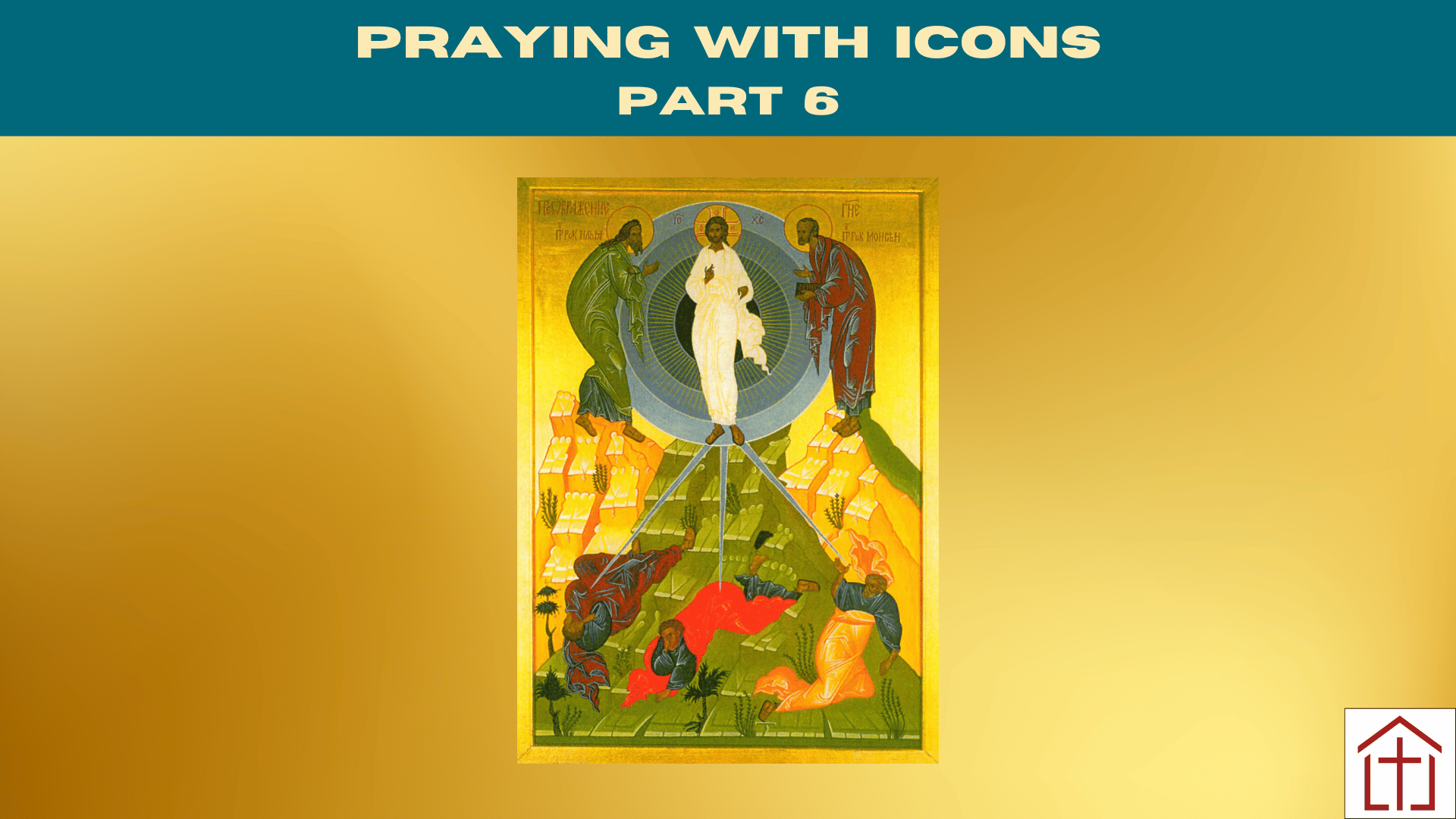
The composition for this icon follows a strictly symmetrical scheme. A stylized mountainous landscape characterized by several stair-like landings forms the background for the incident. Christ stands – or almost floats – on the central peak. He is clothed in a dazzling white robe and surrounded by a mandorla in different shades of blue. On his left he is flanked by Elijah, and on his right by Moses, each standing on his own mountain peak. Three beams of light radiate from the mandorla, each one striking one of the disciples. On the far left, we see James lying on his back after his fall. He covers his face with his hands to prevent him seeing more. John who fell head over heels, supports himself with his right hand and covers his face with the other, while Peter rises up from a kneeling position and raises his right hand to speak.
The Latin word “transfiguratio” can be translated by “to be changed into another form” while the Greek word “metamorphosis” means “to progress from one state of being to another.” The Transfiguration is a revelation of Christ’s divine nature, a manifestation of the Trinity, and confirmation of the continuity between the Old and the New Testaments.
Christ lets his disciples catch a glimpse of a supernatural light with transforming power – they were not blinded by natural sunlight, but by the uncreated light that has its source in God’s own being. Because of his divine identity, Christ is himself that light: “For in him the whole fullness of the Godhead dwells bodily” (Colossians 2:9).
The disciples heard the Father, saw the Son, and were enveloped by the Holy Spirit in the brilliant sky. They also witnessed Moses and Elijah, who represent The Law and The Prophets, confirm that Christ fulfilled the Messianic promises. Because of the Incarnation, the God they had served so faithfully without seeing could be seen and spoken to, face to face.
Moses and Elijah had experienced how God had revealed himself indirectly through supernatural light phenomena in the Old Covenant. The burning bush, the pillar of fire that lead Israel through the wilderness, the light Moses saw on Mount Sinai, the fire on Mount Carmel and the chariot of fire that lifted Elijah up to heaven are examples of such uncreated energies. In the blinding light on Mount Tabor the prophets could contemplate God’s personified radiance directly.
- Source: The Mystical Language of Icons. (over)
Reflections on the Icon of the Transfiguration
Looking at Jesus seriously changes things; if we do not want to be changed, it is better not to look too hard or too long. The apostles in the icon are shielding their eyes, because what they see is not easily manageable in their existing world. As the Eastern Christian tradition has regularly said, the light that flows from Jesus here is not a “created” light – it isn’t a phenomenon of this world, caused by factors within the universe, but a direct encounter with the action of God which alters the whole face of creation precisely because it isn’t just another thing in creation.
So as we look at this icon and let it shape our prayers and reflections, we can think first of that infinite ‘hinterland” that is the background, the inner dimension, of Jesus’ human life. It doesn’t stop being human in any sense; but it is a humanity which in every moment “performs” God’s own life. When we see that, we see that every act and suffering of Jesus is part of the act of God, embraced freely in God’s journey towards us out of his depths. We can also think of how the shape of our own lives is finally going to be in God’s hands, not ours: like Moses and Elijah, we don’t know yet what we shall be. Our time, our stories about ourselves, our histories are the best we can do from where we stand and look; but God’s perspective can do strange things with history, and we are not the best judges of the meanings of our lives, what really matters to God, what shows God to the world.
But we are given a glimpse of what God can do in this rare moment of direct vision, when the “door of perception” is opened by us and in Jesus, and the end of the world is fleetingly there before us. And finally, we can let ourselves contemplate the fact that the divine freedom shown us in this vision tells us both that there is no escape from the world in which we have been put as creatures and that there is nowhere from which God can be finally exiled.
This is the great challenge to faith: knowing that Christ is in the heart of darkness, we are called to go there with him. In John 11, Thomas says to the other disciples, “Let us go and die with him”; and ahead lies death – the dead Lazarus decaying in the tomb, the death of Jesus in abandonment, your death and mine and the deaths of countless human beings in varying kinds of dark night. But if we have seen his glory on the mountain, we know at least, whatever our terrors, that death cannot decide the boundaries of God’s life. With him the door is always open, and no one can shut it.
- Rowan Williams, The Dwelling of the Light, pp. 13, 17 -19.
“Praying with Icons”, Deacon Joe Dzugan, St. Francis Episcopal Church, 2021.