Praying with Icons – Part 2
Praying with Icons – Part 2
It helps to explain why Eastern Christians are so unhappy about statues in church – which they do indeed think of as incompatible with the Commandments. A statue is very clearly an object that takes up a three-dimensional space; you can walk round it. An icon is a surface: you can’t walk round it but only look at it, and, hopefully, through it. It insists that you don’t treat it as an object with which you share a bit of space. In the icon, what you see is human beings and situations as they are in the light of God’s action. When you draw a diagram or even a map, you have to pick out the elements of the view that you need in order to convey what this drawing is for; it is a bit like that with an icon. It doesn’t seek for photographic realism; like the lines of a diagram, the lines of an icon tell you what it is in the subject matter that is significant, that conveys God’s working. And you need to look and pray with that in mind, to look patiently and not analytically, and allow yourself to be “worked on” – perhaps we should say, allow yourself to be looked at by God, rather than just looking at something yourself. –
Rowan Williams, The Dwelling of the Light, p. xvii.-xviii.
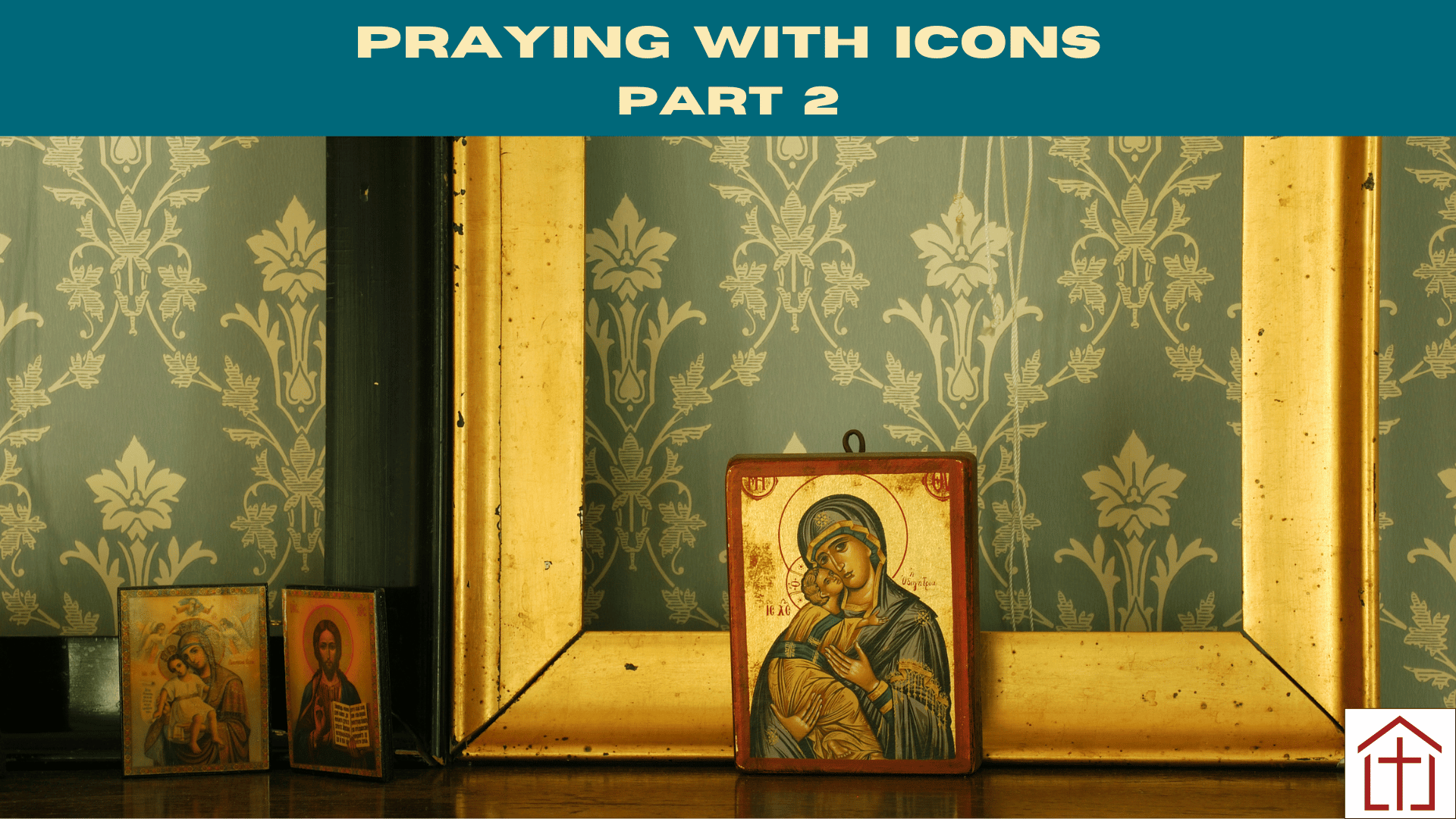
Our Lady of the Sign (The Mother of God of the Sign)
One of the most ancient icons is Our Lady of the Sign, the earliest known example of which is found in the Roman Catacombs. The icon reminds us of the words of St. Paul, “It is no longer I who live but Christ lives in me (Galatians 2:20).
In this icon Mary is seen praying. On her breast is a circular medallion with an inset of the child Jesus. Mother and child are portrayed frontally. Their faces are compassionate and serious, marked by deep calmness and contemplation. It is not the intimacy between mother and child which is primary here, the focus of attention is Mary, who has been given the honorable title of “Theotokos” (The Birth-giver of God), and who is presenting the child to us as the Son of God. Another name for Mary is “Platytera” (Spacious, Wider than). The notion is that God, who could not be contained by the universe, found a place in Mary’s body during her pregnancy. Thus no other human has been close to God as Mary.
The title “Our Lady of the Sign” has its reference in a text from the prophet Isaiah 7:14 – “The Lord himself will give you a sign. Behold, a young woman shall conceive and bear a son, and shall call his name Immanuel.” And as Christ came down to earth, God’s promise that was mediated through Isaiah was fulfilled.
The initials above the shoulders of the child Jesus, IC-XC, are the first and last letters in the Greek spelling of Jesus Christ, and are a fixed attribute on all icons of Christ. Likewise, the inscription above Mary, MHP-OV, is an abbreviation for the Mother of God. The stars on Mary’s shoulders and her headdress symbolize her virginity before, during, and after the birth and underline her unique position as the mother of a child with a divine origin.
This is the theological crux of the icon; with the mystery of the Incarnation, God voluntarily let himself be confined within time and space when becoming man through Jesus Christ. As a minor, he was already filled with divine insight. The icon does not primarily express the likeness of a portrait and thus associate the motif with a certain epoch and a certain place. The stylized facial expression, gesture, and fall of the robes contribute to making the icon universal. The icon has its origin in an historic event, in this instance the Birth of Jesus, but the content is meant to have a universal relevance for all time.
A quotation from St. Augustine sums up the existential meaning thus: “Of what help is it that Jesus was born, if he is not born within me?”
Source: The Mystical Language of Icons.
“Praying with Icons”, Deacon Joe Dzugan, St. Francis Episcopal Church, 2021.