Praying with Icons – Part 1
*(This first session was not recorded)
He [Jesus Christ] is the image [in Greek, ikon] of the invisible God, the firstborn of all creation. – Colossians 1:15
(From the great hymn in Colossians which draws on the Wisdom tradition and the history of Jesus in equal measure.)
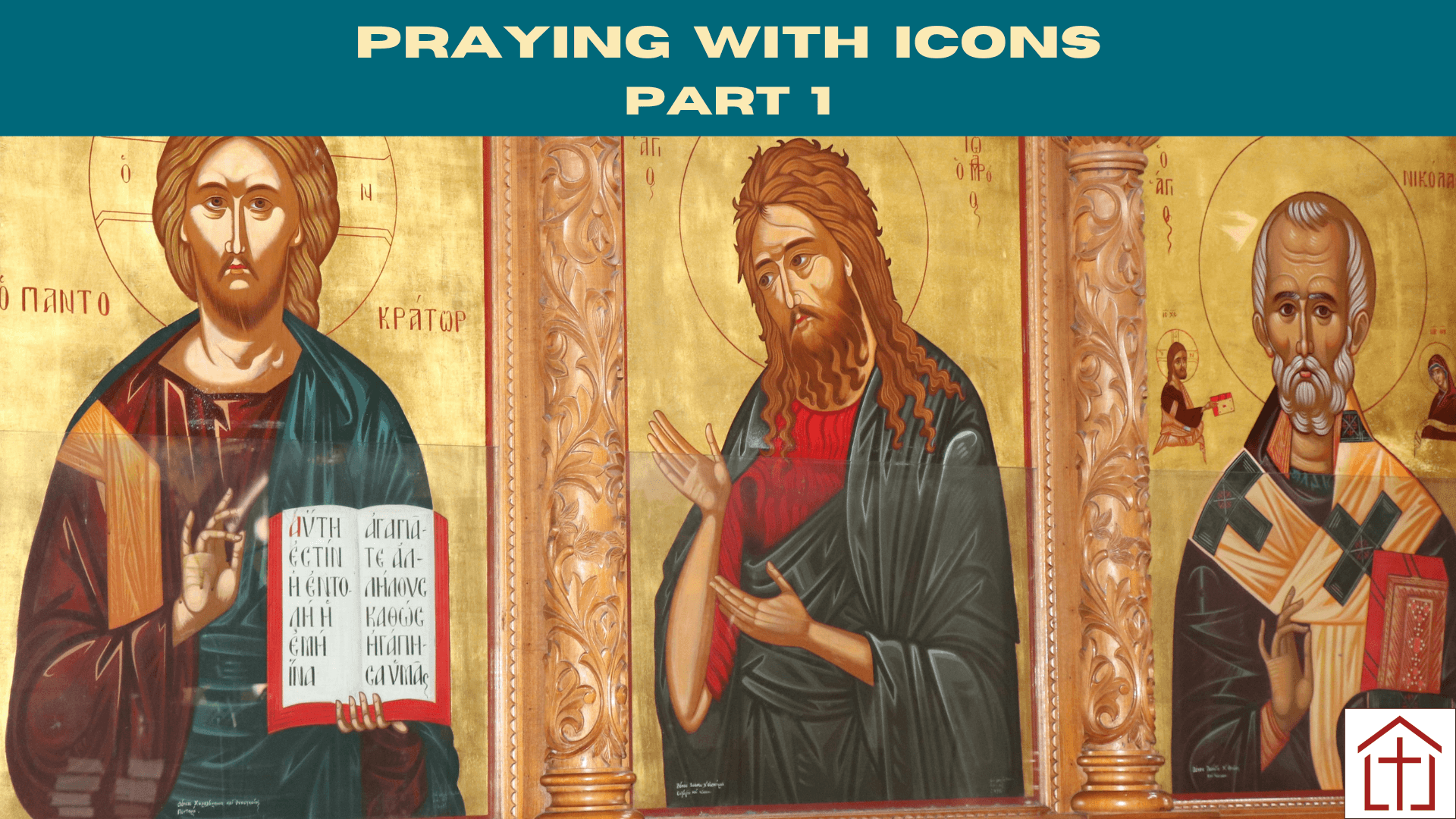
Icons are never portraits, attempts to give you an accurate representation of some human situation or some human face as you normally see it. They are – like all our efforts in Christian living – human actions that seek to be open to God’s action. It sounds a bit strange to call a picture an ‘action’ in this way; but creating an icon is after all something ‘performed’ in a fixed way, with the proper preparation of fasting and prayers, in the hope not that you will produce a striking visual image but that your will open a gateway for God. Just as God works through the human person or event you are painting, you, responding prayerfully to that earlier working by God, seek to allow it to continue in and through your response.
Icons are treated with reverence – not because the icons are seen as magical objects but because in their presence you become aware that you are present to God and that God is working on you by his grace, as he does in the lives and words of holy people, supremely in the words of Scripture and the person of Jesus.
- Rowan Williams, The Dwelling of the Light, p. xvi.-xvii, xix.
Praying in Body and Soul
One of the most important roles played by icons in Christian history has been to proclaim the physical reality of Jesus Christ, God incarnate. He had, and has, a face. He had, and has, a body. In icons of Mary holding her son, we always see his bare feet, a reminder that he walked on earth. He was born, lived, died, and rose from the dead, breaking bread with disciples in Emmaus, eating fish with them in Galilee, inviting Thomas to feel the wound in his side. Nearly all the miracles Jesus performed were physical healings. So important is the human body that most questions to be asked of us at the Last Judgment have to do with our merciful response to the physical needs of others: “I was hungry and you fed me, I was thirsty and you gave me drink, I was naked and you clothed me, I was homeless and you gave me shelter, I was sick and you cared for me . . . “ (Matthew 25:34-37). It is through the protective care for creation, most of all care for each other, that we most clearly manifest our love of God.
One of the odd things that has happened to prayer in much of Western Christianity – in some churches with the Reformation, in others more recently – has been the dramatic erosion of the physical dimension of spiritual life. Prayer has become mainly an activity of the head. Many of us have become like birds trying to fly with one wing. Icons can help us grow back the missing wing, the physical aspect of prayer.
Do you pray with your eyes closed? Because icons are physical objects, they serve as invitations to keep our eyes open when we pray. While prayer may often be, in Thomas Merton’s words, “like a face-to-face meeting in the dark,” cutting a major link with the physical world by closing your eyes is not a precondition of prayer. Icons help solve a very simple problem: If I am to pray with open eyes, what should I be looking at? It doesn’t have to be icons, but icons are a good and helpful choice. They serve as bridges to Christ, as links with the saints, as reminders of pivotal events in the history of salvation.
- Jim Forest, Praying with Icons, pp. 40-41.
“Praying with Icons”, Deacon Joe Dzugan, St. Francis Episcopal Church, 2021.