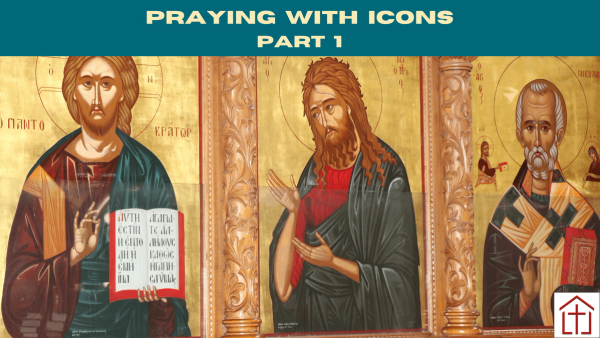
Have Mercy: Following Jesus in Politically Challenging Times Part 3
Opening Prayer
Light, golden light fresh from the source. Colors, creation’s colors calling our senses. Life, life in its oneness, life in its manifold oneness all from You. You are the Sun from whom the morning shines. You are the River in whom each life-form flows, each face, each race, each cell within our ever-living soul. This new day we greet You.
- John Philip Newell, Praying with the Earth – A Prayerbook for Peace, p. 10.
Have Mercy: Following Jesus in Politically Challenging Times -
Encouragement to bear courageous witness rooted in the Gospel. An invitation to consider together how core Gospel commitments such as loving our neighbor, welcoming the stranger, and telling the truth can shape faithful Christian discipleship in today's political climate.
“Definition” of Mercy (cont’d)
"God is infinitely good and merciful. It is the expression of his love, goodness, and desire to bring us back to Himself, even when we have sinned."
- Bob Isner
Theology in Politically Challenging Times
“The call to have mercy, stands within scriptural, liturgical, and spiritual tradition. God is merciful, and therefore we can have mercy on others. And here is the further [controversial] claim: in showing mercy, we are acting politically; we are engaging in politics. This is a central argument, but it is controversial. The frequently made assertion that the church ought to stay out of politics has gathered urgency in recent times with the rise of Christian nationalism. Christian nationalism advocates the use of all the tools of governance, including legal sanction and violence, to enact a particular theological vision. In a rather circular logic, Christian nationalists place the nation, rather than God, at the center of their worship and use the power of the state to enact their theological vision. At root, the problem is idolatry: Christian nationalists place the nation above God, and that false worship creates the conditions for violence against fellow citizens, the poor, the immigrant, and many, many other groups. Christian nationalists engage in politics in ways that distort the Christian faith and do harm to the common good.”
“Given this theological error, it might be tempting to say, ‘Let’s just get theology out of our politics altogether.’ And this is the temptation on the other side: to remove theology completely from the public square. But this is problematic, too, for both political and theological reasons.”
“Politically, a democratic commitment to pluralism demands that we bring all our commitments, including faith, into the public sphere where we encounter others with different values and commitments. We don’t achieve democracy by hiding some of our deepest-held values out of view. Rather, we do so by holding tightly to our core convictions while engaging with respect and forbearance those who are different than us. Theologically, to do justice to the preaching of the Gospel we have to engage politics. The early Christians borrowed their shared lexicon from politics: ecclesia, sacramentum, gospel, and leitourgia are all political terms. If we define politics as the process of making decisions about shared goods, Christians have good reason to engage in politics.”
“Bishop Budde’s witness demonstrated that we do not have to choose between the false choice of Christian nationalism on the one hand and secular evacuation of the public sphere on the other. In her call
to the president to ‘have mercy,’ she was engaging in political action. However, in doing so, she was proclaiming that Christians need not engage in politics in the way that the world does politics. The call to ‘have mercy’ points to the fact that Jesus’ message is political in a particular way, in a way that puts mercy at the center. Jesus announced a reign that had no military, maintained unclear borders, and turned conventional values upside down. He called for compassion, even for the enemies, as a fundamental way of living. He preached a politics that attends to the least of these, placing the margins at the center. He modeled a politics that confronts our dominant perceptions of worth and value. But most of all, in centering mercy, Jesus demonstrated and invites his followers into a politics that is incarnational. We must, as Pope Francis encouraged, look the poor in the eye and touch their hand when we give them alms. The plea to have mercy, to practice the works of mercy, is not merely spiritual. It is also political. The politics of mercy are fleshy, incarnational, personal, gritty, joyful, and life-giving.”
(Ruthanna B. Hooke, Kyle B. T. Lambelet, and Altagracia Perez-Bullard, editors, Have Mercy, 2026.)
For this week: For reflection: When have you seen connections between your spirituality and your public life?
An invitation to our virtual participants: Discussion and comments are very much encouraged and welcomed. Online discussions can be held in the comments section in the upcoming post on Social Media for this week’s Deacon’s Reflection which is part of adult formation at St. Francis Episcopal Church.
Closing Prayer – Prayer of Blessing
May the angels of light glisten for us this day. May the sparks of God’s beauty dance in the eyes of those we love. May the universe be on fire with Presence for us this day. May the new sun’s rising grace us with gratitude. Let earth’s greenness shine and its waters breathe with Spirit. Let heaven’s winds stir the soil of our soul and fresh awakenings rise within us. May the mighty angels of light glisten in all things this day. May they summon us to reverence, may they call us to life.
May the light of God illumine the heart of my soul.
May the flame of Christ kindle me to love.
May the fire of the Spirit free me to live this day, tonight, and forever. Amen.
- John Philip Newell, Praying with the Earth - A Prayerbook for Peace, p. 4.
May the light of God illumine the heart of my soul.
May the flame of Christ kindle me to love.
May the fire of the Spirit free me to live this day, tonight, and forever. Amen.
- John Philip Newell, Celtic Benediction, p. 5.
Have Mercy: Following Jesus in Politically Challenging Times,” Deacon Joe Dzugan, St. Francis Episcopal Church, 2026.