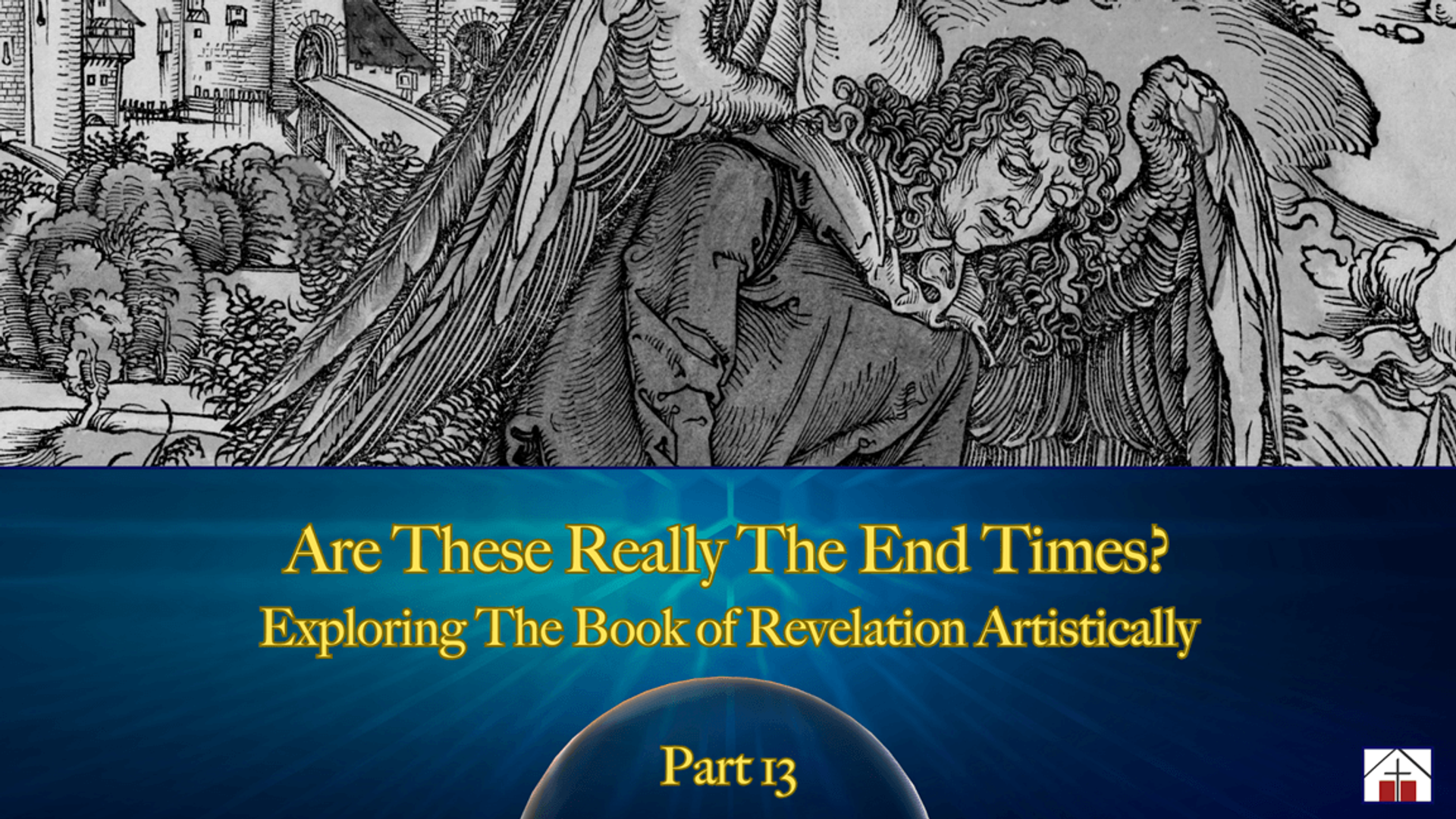
Are These Really The End Times? – Exploring The Book of Revelation Artistically – Part 13
Opening Prayer
You know what is within us, O God. You know the beauty and the falseness of our hearts. You know the heights and depths of the human spirit. Lead us further into the universe of our souls that we may know the wisdom and strength that you have placed within us. Lead us further into the mystery of our souls that we may be strong and wise for the well-being of the world.
- J. Philip Newell, Celtic Treasure – Songs of the Soul, p. 168.
Are These Really The End Times? – Exploring The Book of Revelation Artistically:
The Book of Revelation is the strangest book in the Bible – and the most controversial. Instead of stories and moral teaching, it offers only visions – dreams and nightmares. These sessions are for all who seek to move beyond the quest to decode this book with plain answers and find an alternate way to navigate the Book of Revelation.
The End (Revelation 19-22) – The Millennial Kingdom (20:1-6)
“This peculiar cyclical structure of Revelation directs attention to God and the Lamb as the End of all things. By taking readers through a dizzying spiral of visions, Revelation helps to undercut the readers’ confidence that they can know the steps by which future events will unfold. Those who find a kind of security in knowing where they are on God’s timeline subtly fall prey to a false faith, because God keeps the secrets of his coming hidden from human eyes. Therefore, the kaleidoscopic changes in images that overlap with each other and convey similar messages in multiple guises actually help to show readers the limits of their own abilities to determine where they are in time. As Revelation’s spirals unsettle readers, however, they repeatedly bring back readers to the presence of God and the Lamb, who are worthy of the readers’ trust (1:12-20; 4:1-5:14; 7:9-17; 11:15-19; 15:2-4; 19:1-10; 21:1-22:5).”
“Modern readers often turn to Revelation’s final chapters with a mixture of dread and fascination that is fueled by the popular use of Revelation’s imagery for the future annihilation of civilization. This picture is frequently overlaid with references to current developments in military technology and global politics. Some modern writers assume that when John writes about winged creatures, armies mounted on horses, and smoke rising from the bottomless pit, he really refers to squadrons of supersonic jet aircraft, missiles bearing nuclear warheads, battalions of tanks, laser weapons, and rising clouds of chemical gasses. The practice is so common that images from Revelation are readily used in this way by many who have never read the book itself, so that in popular imagination, the road to Armageddon leads to the mushroom cloud that signals nuclear annihilation.”
“Revelation does depict warfare, but of a different sort. By describing a battle that is waged and won by a word that is visualized as a sword, John shows that he is not describing an ordinary conflict, but using language to speak of the ultimate triumph of God over evil. (Revelation chapter 19)”
“The defeat of the beast and the false prophet quickly leads to a mop-up operation in which an angel binds Satan, who was the power behind the beast’s throne. The angel binds Satan with a chain and throws ‘that ancient serpent’ into the bottomless abyss, which the angel locks with a key. This action further restricts Satan’s operations by barring him from earth itself for a period of a thousand years.”
“After the angel has sealed the door over the abyss, John tells of a kingdom in which the saints reign with Christ for a thousand years. Tradition has long pictured the millennial kingdom as an earthly kingdom in which Old Testament promises come to fulfillment.”
(Koester)
An interesting note: “In the twentieth century, Adolf Hitler, encouraged by his minister of
propaganda, Joseph Goebbels, apparently read himself into John’s visions, as one divinely chosen to initiate what he proudly calls the Third Reich, which suggested not only Germany’s third kingdom, but also Christ’s thousand-year kingdom on earth, while countless others pictured Hitler instead as the furious and diabolical ‘beast’ who makes war on God’s people.”
(Pagels)
There are several major ways “in which theologians have dealt with Revelation’s reference to the thousand-year kingdom. The usual labels identify ways in which this passage is incorporated into a theological system. Premillennialism affirms that Christ will return before (‘pre’) the millennium. [See Part 2 for a discussion of Dispensational Premillennialism.] Postmillennialism holds that Christ will return after (‘post’) the millennium. Amillennialism describes theological systems that do not include an explicit thousand-year period in their understanding of time. Augustine is a representative of this approach. Some, who take a rather quizzical view of the whole discussion, have humorously suggested other options. One is ‘pro-millennialism,’ meaning ‘if there is a millennium, I’m all for it.’ The other is ‘pan-millennialism,’ meaning ‘I’m sure it will all pan out in the end.’”
(Koester)
(Source: Craig R. Koester, Revelation and the End of All Things; Elaine Pagels, Revelations – Visions, Prophecy, & Politics in the Book of Revelation.)
For this week: For reflection:
- Read Revelation 20:11-15. “This vision is of the final judgment. When this vision comes to an end, everything of the present creation – the heavens and the earth, even death and the grave – have either fled or have been destroyed by the fiery lake.”
(Source: The CEB [Common English Bible] Lectio Divina Prayer Bible.)
An invitation to our virtual participants: Discussion and comments are very much encouraged and welcomed. Online discussions can be held in the comments section in the upcoming post on Social Media for this week’s Deacon’s Reflection which is part of adult formation at St. Francis Episcopal Church.
Closing Prayer – Prayer of Blessing
The blessings of heaven, the blessings of earth, the blessings of sea and of sky. On those we love this day and on every human family, the gifts of heaven, the gifts of earth, the gifts of sea and of sky.
May the light of God illumine the heart of my soul.
May the flame of Christ kindle me to love.
May the fire of the Spirit free me to live this day, tonight, and forever. Amen.
- J. Philip Newell, Celtic Treasure – Songs of the Soul, p. 169.
“Are These Really The End Times? – Exploring The Book Of Revelation Artistically,” Deacon Joe Dzugan, St. Francis
Episcopal Church, 2025.