Are These Really The End Times? – Exploring The Book of Revelation Artistically – Part 11
Opening Prayer
Give us peace in our days, O God. Let us live in harmony with one another. Let us care for the earth and its creatures. Let us be true as nations. Let us guard one another’s dignity. And let us protect the peace that belongs to the whole of creation.
- J. Philip Newell, Celtic Treasure – Songs of the Soul, p. 160.
Are These Really The End Times? – Exploring The Book of Revelation Artistically:
The Book of Revelation is the strangest book in the Bible – and the most controversial. Instead of stories and moral teaching, it offers only visions – dreams and nightmares. These sessions are for all who seek to move beyond the quest to decode this book with plain answers and find an alternate way to navigate the Book of Revelation.
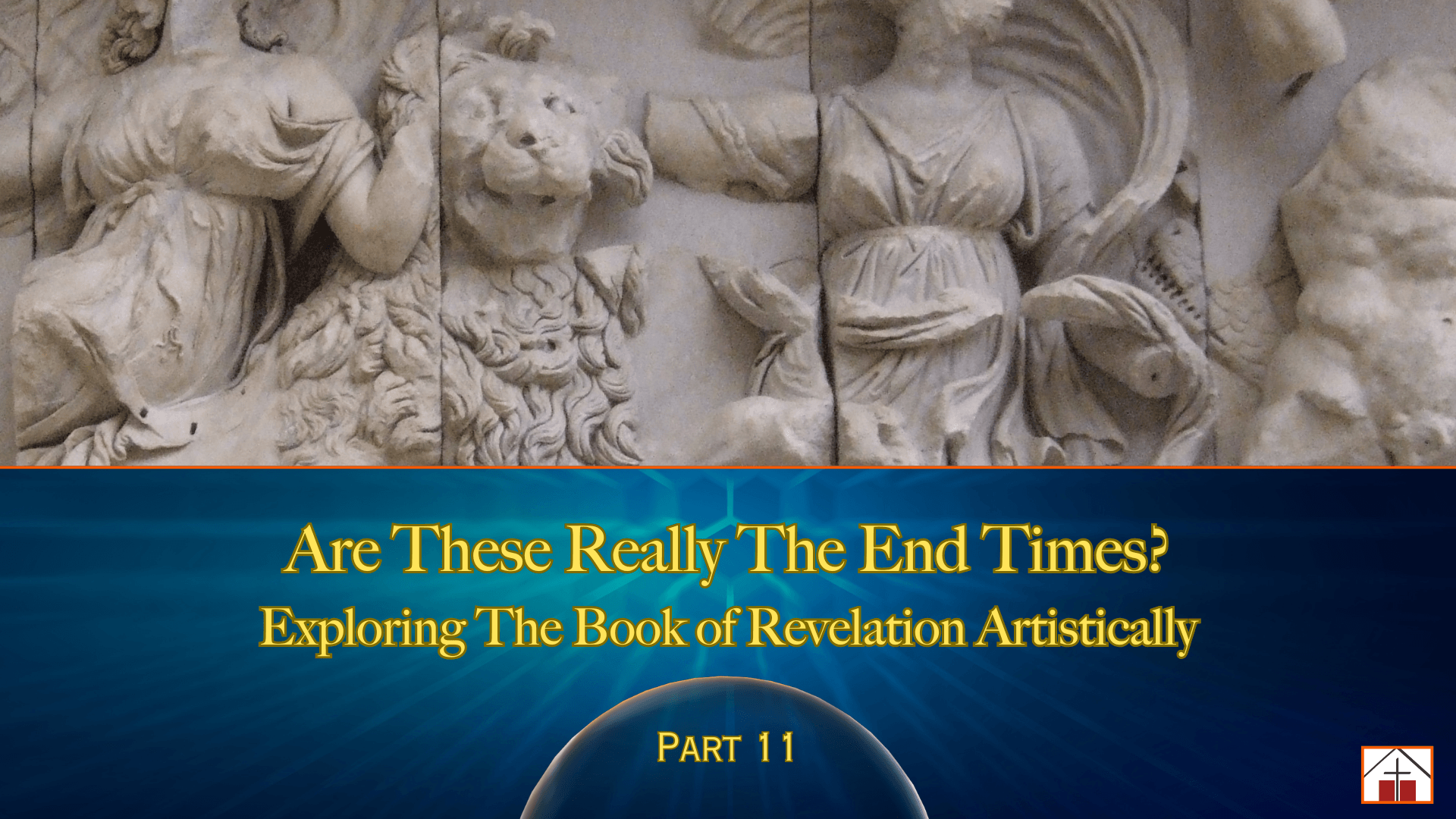
The Four Creatures and The Four Gospel Writers
“Beginning in the late second century A.D., Christian writers identified the four creatures in the heavenly throne room with the four gospel writers. Those who read Revelation at the end of the first century would not have understood the creatures in this way since it was only later that Christians agreed that there were to be only four authoritative gospels. Over the centuries, however, the use of these images for the gospels has become commonplace. Interpreters have not always agreed on which creature represents which gospel, but the most common view is as follows: Matthew’s gospel has the human face because it begins with a genealogy that traces Jesus’ human origins. Mark is identified with the lion because it begins by calling Jesus the ‘son of God,’ referring to his royal power. Luke is the ox, since his gospel begins in the temple where sacrifices were made. John is the eagle, since his soaring introduction of Jesus as the Word of God points to his heavenly origin.” (Koester)
The Heavenly Throne Room (Revelation 4:1-11) – (cont’d)
“The actions that occur in the heavenly throne room show that in the proper order of things, all creation is oriented toward its Creator. Human beings are not at the center, much as they like to think that they are. God is central, and the second ring of beings consists of four creatures, only one of whom has a human face. The others resemble a lion, an ox, and an eagle (cf. Ezekiel chapter one), and all have six wings (Isaiah 6:2). Representing the entire created order, these creatures lead all living things in worship of their Creator. They voice one of the primary forms of awareness of God, which is that God is supremely ‘holy’ (4:8). God’s holiness is his ‘otherness.’ It is the numinous quality of power and purity that sets God apart from all other beings, so that those who recognize God’s holiness also recognize their own powerlessness and impurity (Isaiah 6:3-5). The four creatures begin their song by acclaiming God ‘holy’ (4:8), but they add their ‘Amen’ only when every creature in heaven and on earth and under the earth and sea offers it praises at the end of the scene (5:14).”
“The next ring of heavenly figures consists of the twenty-four elders that look like kings (4:4). Interpreters have tried to determine whether they represent the twelve sons of Jacob and the twelve apostles, or a group of priestly figures, or another type of heavenly being. John, however, simply calls them ‘elders,’ leaving many questions about their identity unanswered. The term ‘elder,’ which is presbyteros in Greek, was often used for the leaders of Jewish and Christian communities. By looking at the elders, the readers in the seven congregations can see the outcome of Christ’s promises concerning the faithful. Earlier, Christ promised that the faithful would wear white robes (3:5), that they would be given crowns
(2:10), and that they would have a place on Christ’s throne (3:21). This vision underscores the promise by depicting a group of elders clothed in white robes, wearing crowns, and sitting on thrones.”
“The twenty-four elders take up the song of praise that the four creatures began and now speak of the dependence of all creation upon God. In a three-fold way the four creatures proclaimed God’s infinite existence by calling him the one who “was and is and is to come’ (4:8). Now in a threefold way the twenty-four elders voice finite creation’s dependence upon the Eternal One by confessing that God created all things, that it was by God’s will that they came into being, and that it was by God’s power that they were created (4:11). The actions of the elders match their words. Instead of celebrating their own reign, they direct attention to God’s reign. Their thrones and their crowns are theirs not by right, but as gifts from God. Therefore, the elders honor the Giver and dispel any illusion that they themselves possess ultimate authority by removing the crowns from their heads and casting them down before God’s throne (4:10).”
“The heavenly throne is the vantage point from which John wants readers to look out upon the world of human affairs. Popular culture in the world of the seven [congregations] gravitated toward human centers of power. Public appearances of the emperor often featured him sitting on a throne and accompanied by a crowd of friends, advisors, and attendants. When the emperor traveled, communities would send representatives, sometimes dressed in white, to greet him and present him with golden crowns to show their recognition of his sovereignty. Those who approached the throne would prostate themselves, sometimes even bowing down before the throne when the emperor was absent.”
“By giving readers a glimpse of God’s heavenly court, John presses Christians in the seven [congregations] to see such popular displays of power as garish imitations of the true sovereignty that belongs to the Creator, who alone is truly worthy of being called ‘Lord and God’ (Rev. 4:11). The vision of God’s court also sets the stage for the drama that will follow, in which kaleidoscopic cycles of images unmask the pretensions of powers that seek to take God’s place so that readers can see how the forces of evil infiltrate political, economic, and social life. God’ throne remains the true seat of power throughout Revelation. Yet John also speaks of the ‘throne’ of Satan, who exercises power through agents that deceive people and perpetrate violence against the faithful, including Antipas and other Christians (2:13). In contrast to the creatures around the throne, the forces of evil that are represented by the dragon and the beast refuse to acknowledge God’s power. Paradoxically, the twenty-four elders gracefully surrender their crowns and thrones to God while they remain in heaven, but the dragon doggedly retains its crowns as it is driven out of heaven toward final defeat (12:7-9).”
“How would the vision of the heavenly throne room strike the members of the seven [congregations]? Since the situations of the readers varied, their responses to the vision would probably have varied also. First, Christians facing the threat of persecution might have found the vision reassuring, since it shows that God reigns despite the hostility that they receive from human beings. Power ultimately rests in the hands of the Creator, not their accusers. Second, those seeking to accommodate pagan culture would probably have been uneasy with the vision, for if God reigns, then compromising one’s convictions for the sake of social and economic ease warrants the censure they received in Revelation 2-3. In allying themselves with the non-Christian world, they distance themselves from the heavenly court. Third, the complacent and self-satisfied would probably have found the vision disturbing, for in comparison to the splendor of God’s presence, their pride in wealth and prestige is shown to be an act of self-deception. But whether the vision is initially assuring or disturbing, it is designed to attract all types of readers to the heavenly chorus, where they too might join in singing praises to God and the Lamb.”
(Koester)
(Source: Craig R. Koester, Revelation and the End of All Things.)
For this week: For reflection: (Repeat)
- Read Revelation 6:1-8. “When the four living creatures speak, they speak on God’s authority. When the four horsemen act, it is because God allows them to act.”
- Read Revelation 6:9-11. “Fidelity to Christ results in sharing his fate. Evil shall not prevail. To embrace Christ in faith has never been without its penalty.”
- Read Revelation 6:12-17. “The events that take place when the sixth seal is opened are God’s responses to the request in Revelation 6:10 for quick justice.”
(Source: The CEB [Common English Bible] Lectio Divina Prayer Bible.)
An invitation to our virtual participants: Discussion and comments are very much encouraged and welcomed. Online discussions can be held in the comments section in the upcoming post on Social Media for this week’s Deacon’s Reflection which is part of adult formation at St. Francis Episcopal Church.
Closing Prayer – Prayer of Blessing
The blessings of heaven, the blessings of earth, the blessings of sea and of sky. On those we love this day and on every human family, the gifts of heaven, the gifts of earth, the gifts of sea and of sky.
May the light of God illumine the heart of my soul.
May the flame of Christ kindle me to love.
May the fire of the Spirit free me to live this day, tonight, and forever. Amen.
- J. Philip Newell, Celtic Treasure – Songs of the Soul, p. 161.
“Are These Really The End Times? – Exploring The Book Of Revelation Artistically,” Deacon Joe Dzugan, St. Francis
Episcopal Church, 2025.